
Over the last few years, coaching for competitive exams has changed a lot. Earlier, if a student wanted to prepare for exams like NEET, JEE, SSC, Banking or UPSC, joining an offline coaching institute was almost the only option.
Today, things are very different. Online coaching platforms have grown rapidly, offering live classes, recorded lectures, doubt sessions, test series and even personal mentoring — all through a phone or laptop. Because of this shift, many students and parents are confused: Online Coaching vs Offline Coaching .
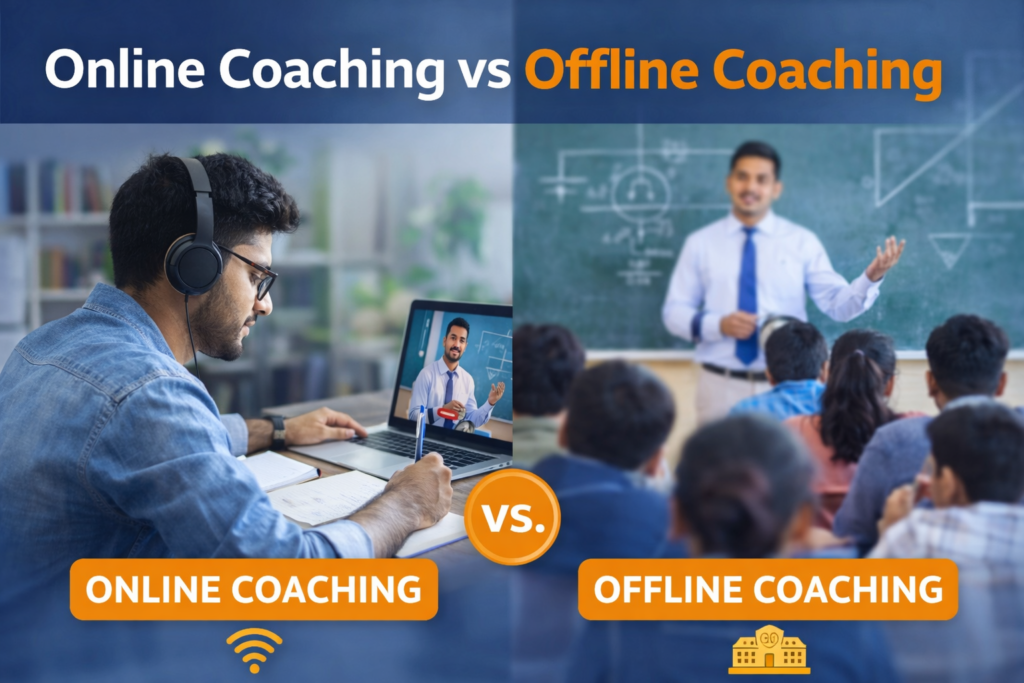
Understanding Online Coaching-
Online coaching means studying through digital platforms. Classes are conducted via apps or websites, either live or recorded. Students can attend sessions from home, revise lectures anytime, and practice through online tests and assignments.
In recent years, online coaching has become popular mainly because of flexibility, affordability, and accessibility. A student from a small town can now learn from top teachers without relocating.
However, online coaching is not just about convenience. It also demands self-control and consistency, which not every student finds easy
Understanding Offline Coaching
Offline coaching refers to the traditional classroom model. Students attend physical classes at a coaching institute, follow a fixed timetable, interact directly with teachers, and study alongside peers.
Offline coaching is still preferred by many students because of its structured environment, personal supervision, and discipline. Being physically present in class creates pressure to stay focused, which helps some students perform better.
At the same time, offline coaching comes with challenges like higher costs, travel time, and limited flexibility.
Learning Environment: Home vs Classroom
One of the biggest differences between Online Coaching vs Offline Coaching is the learning environment.
In offline coaching, students are surrounded by other aspirants. The classroom atmosphere naturally pushes students to stay attentive. Teachers can observe body language, notice confusion, and address issues immediately. Many students feel more serious and motivated in a classroom setup.
In online coaching, the environment depends entirely on the student’s home conditions. Some students have a quiet space and supportive family, which works perfectly. Others struggle with distractions like mobile phones, noise, or lack of routine. Online learning gives freedom, but with freedom comes responsibility.
If a student can sit alone, focus for long hours, and follow a routine without external pressure, online coaching can work extremely well. If not, offline coaching may offer better discipline
Quality of Teaching: Is One Better Than the Other?
Many people assume offline coaching automatically means better teachers. That is not always true anymore.
Online platforms today have some of the best educators in the country, many of whom previously taught in top offline institutes. Online coaching allows one teacher to reach thousands of students, which was not possible earlier.
Offline coaching still has an advantage when it comes to personal interaction. Asking doubts face-to-face, getting instant feedback, and having direct discussions can sometimes make concepts clearer.
However, online coaching compensates with features like:
- Recorded lectures for revision
- Pause and replay options
- Dedicated doubt-solving sessions
- One-on-one mentoring (in some courses)
So in terms of teaching quality, both can be equally good, provided the student chooses the right platform or institute.
Flexibility and Time Management
Flexibility is where online coaching clearly stands out.
Online coaching allows students to:
- Study at their own pace
- Rewatch difficult topics
- Adjust study hours according to school or college
- Save travel time
This is especially helpful for:
- School-going students
- College students
- Droppers managing multiple subjects
Offline coaching usually follows a fixed timetable. While this creates discipline, it leaves little room for personal planning. Missing a class due to illness or travel can create gaps, and catching up is not always easy.
Students who like freedom and personalized schedules often find online coaching more comfortable
Cost Comparison: A Big Deciding Factor
Cost plays a major role, especially for middle-class families.
Offline coaching is generally expensive. Apart from tuition fees, students may have to spend on:
- Hostel or PG rent
- Food and living expenses
- Transportation
- Study materials
Online coaching is usually much more affordable. Most platforms offer complete courses at a fraction of offline fees. There are also EMI options, discounts, and free resources.
For many students, online coaching has made quality education accessible without financial burden. That said, cheaper does not always mean better — students must still choose wisely.
Doubt Solving and Student Support
Offline coaching has an advantage in instant doubt resolution. Students can raise their hands in class, talk to teachers after lectures, or visit doubt counters.
Online coaching handles doubts differently. Doubts are usually cleared through:
- Live chat during classes
- Dedicated doubt sessions
- Discussion forums
- One-on-one mentor calls
Some students find online doubt-solving effective, while others miss face-to-face explanations. It largely depends on how active the platform is and how comfortable the student is with asking doubts online.
Peer Competition and Motivation
Being surrounded by competitive students can be motivating.
Offline coaching naturally creates competition. Seeing others work hard, score well in tests, or discuss concepts can push students to improve.
Online coaching lacks physical peer presence, but many platforms now use:
- Leaderboards
- Online test rankings
- Discussion groups
- Community features
Still, self-motivation plays a bigger role in online learning. Students who rely heavily on external motivation may perform better in offline coaching.
Discipline and Self-Control
This is the most important factor.
Offline coaching enforces discipline. Attendance, fixed schedules, and teacher supervision keep students on track.
Online coaching gives freedom, but also tests discipline. Without self-control, students may procrastinate, skip lectures, or fall behind.
Honest truth: Online coaching works best for self-disciplined students. Offline coaching supports those who need structure.
Which One Should You Choose?
There is no universal answer. Ask yourself these questions:
- Can I study alone without distractions?
- Do I need constant supervision?
- Is relocating financially possible for me?
- Do I prefer fixed routines or flexible schedules?
- Am I comfortable learning through screens?
If you are disciplined, comfortable with technology, and want flexibility — online coaching can be an excellent choice.
If you struggle with focus, need personal push, and prefer classroom learning — offline coaching may suit you better.
Some students even combine both: online lectures with offline test series or mentorship.
Final Thoughts
Online coaching and offline coaching are not enemies. They are simply two different paths to the same goal. Success depends more on the student’s effort, consistency, and mindset than the mode of coaching.
In today’s time, smart students choose what fits their personality rather than blindly following trends. Whether online or offline, what truly matters is how sincerely you study every single day.